Chibi Akaza by Chibi Station - Kit Overview
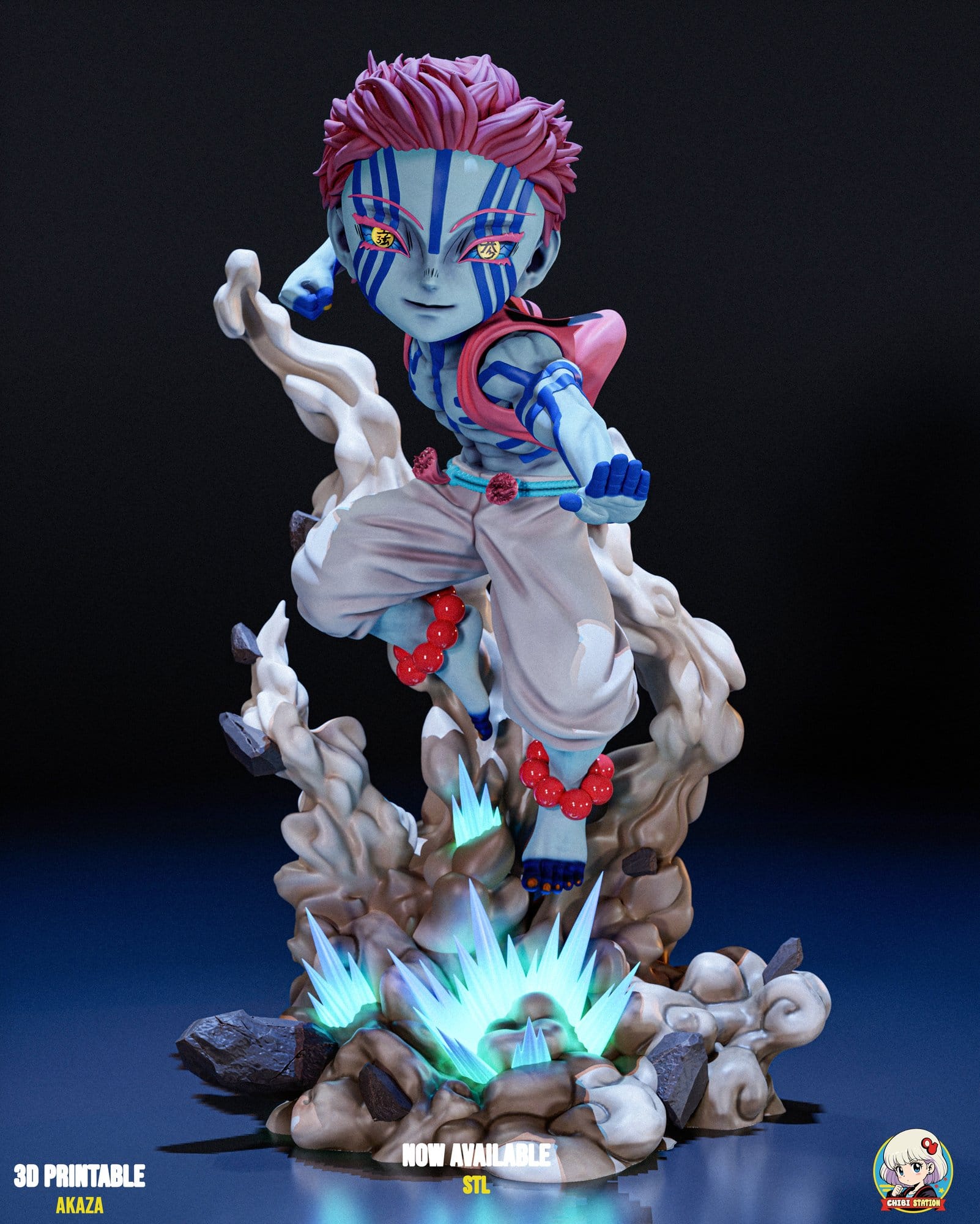
Akaza from Demon Slayer as a Chibi Station chibi, leaping out of a dust crater with cyan spike bursts at his feet. The base is a tall dust column and crater, and it comes as one piece or six.
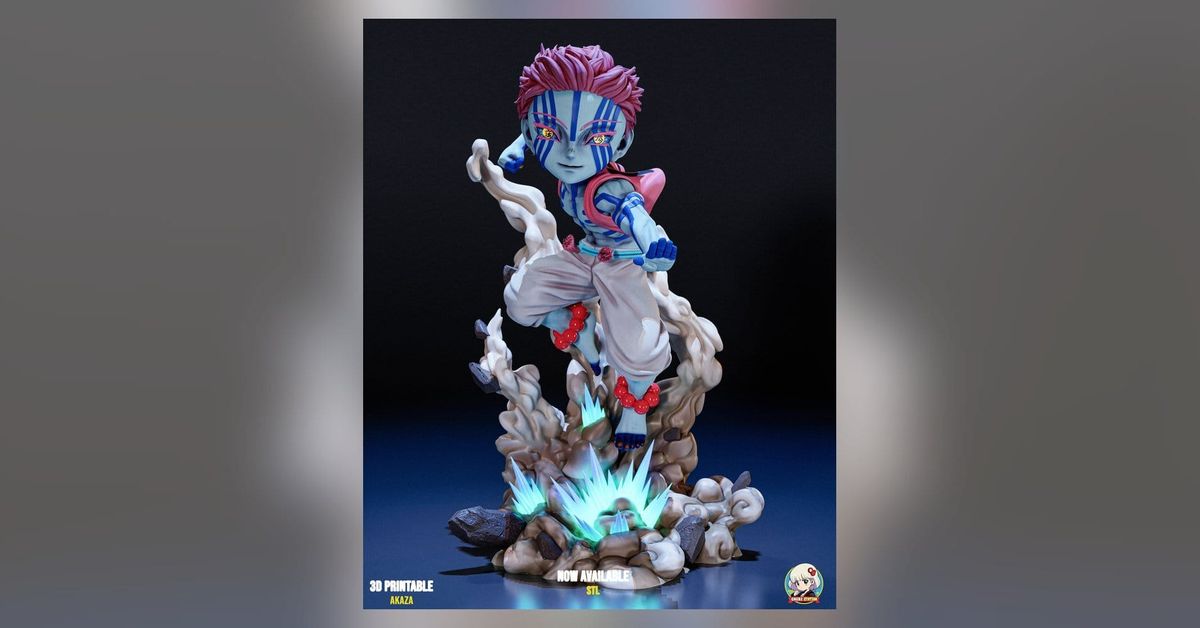
Akaza from Demon Slayer, sculpted as a chibi by Chibi Station, caught mid-leap out of a dust crater with cyan spike bursts breaking out under his feet. What's notable is the base: a tall dust column and crater, supplied as either one piece or six smaller sections.
This post is written from the studio's files and renders. I have not printed it yet.
At a glance
- Studio: Chibi Station
- Character and source: Akaza, Demon Slayer
- Section: Anime
- Versions and sizes: one figure with two base options, a one-piece base (
BASE_FULL.stl) or a six-piece split base (BASE1–BASE6). Roughly 210 × 126.1 × 121.3 mm (H × W × L) either way. There is no dimension sheet, so every size here comes from the STL bounding boxes. Width and length are the base footprint; the height is my estimate from stacking the parts against the renders. - Size note: The studio doesn't give an assembled height for this kit. The height here, about 6 to 9 inches, is my estimate from the STL files.
- Parts per version: 16 with the full base (8 figure parts, 7 effects, 1 base). 21 with the split base (8 figure, 7 effects, 6 base).
- Presupports: none. Chibi Station ships raw STLs only for this kit: no presupported files and no slicer project.
- Largest part and plate fit: full base build,
BASE_FULL.stlat 126.1 × 167.6 × 121.3 mm, which fits a Saturn-class plate but not Mars-class in any orientation. Split base build,BASE5.stlis the tallest (85.3 × 33.4 × 103.7 mm) andBASE2.stlthe longest (66.6 × 114.7 × 52.5 mm); every split-build part fits Mars-class. - Ratings (estimated): Print 4/5. Assembly 3/5 with the full base, 4/5 with the split base. Paint 4/5. Skill level: advanced.
- Status: files reviewed, not printed.
- Where to get the files: from the studio, Chibi Station.
The model
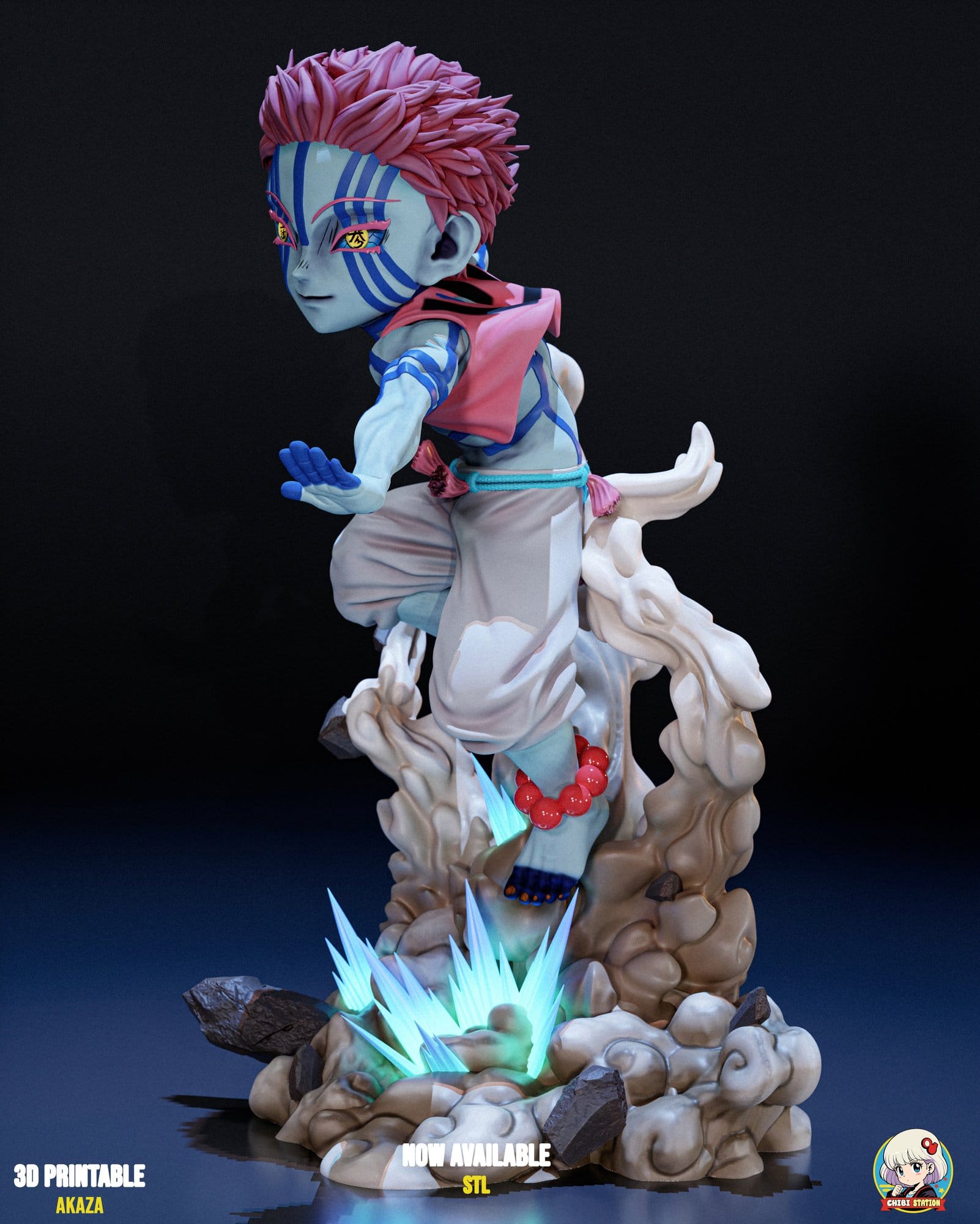
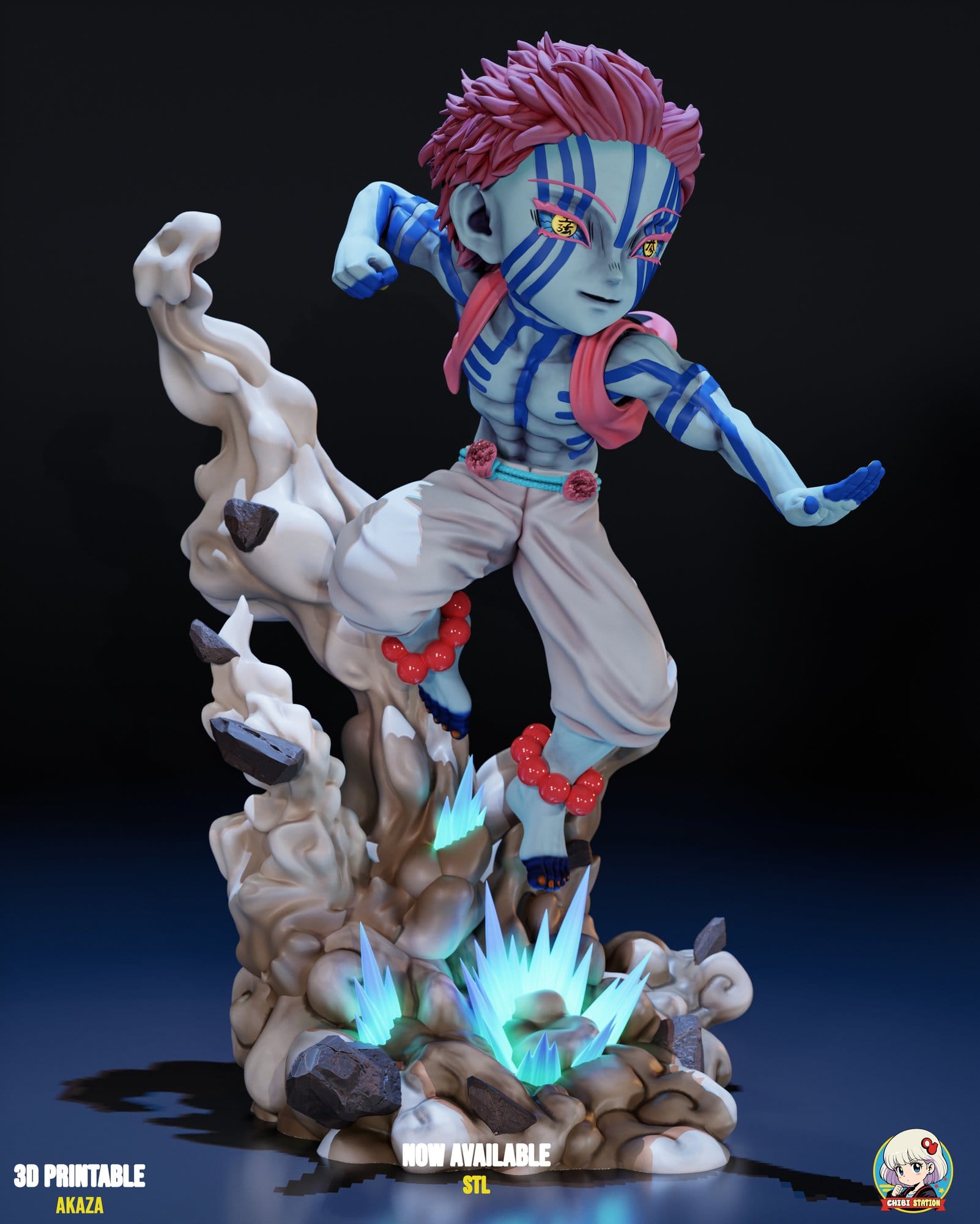
Akaza is caught mid-leap, coming up out of a burst of dust. His right knee is pulled up high and his left leg reaches down, so the toes of his left foot just touch a rock at the edge of the crater. His right fist is cocked high beside his head. His left arm is thrust forward with the hand open and the fingers held together like a blade. His head tips forward and down, so he looks at you from under his hair. It reads as the moment before a strike.
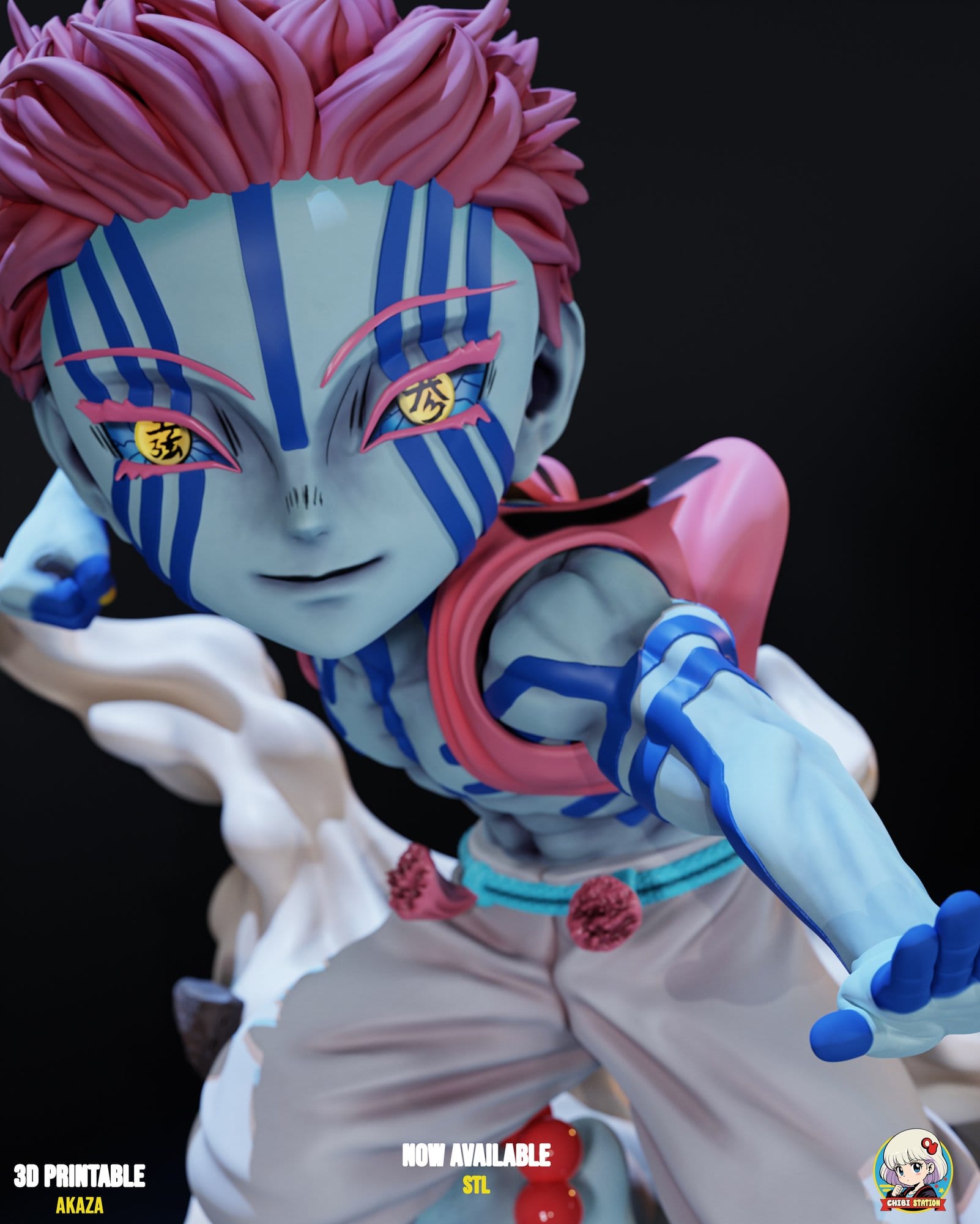
The head is the chibi part of the sculpt: the hair alone is 47.8 mm across against a 41.8 mm torso. His skin is a pale blue-gray, and dark blue stripes run over all of it. On the face there is one stripe down the center of the forehead and a band of three lines down over each eye and cheek. The eyes are gold, each with a dark kanji in the iris (弦 in one, 参 in the other in the close-up), set in blue sclera with darker blue veining. Magenta-pink flicks line the upper and lower lids, and a pink stroke arcs over each brow. Fine dark lines sit under the eyes and on the bridge of the nose. The mouth is a closed, thin smirk. His ears come to a slight point.
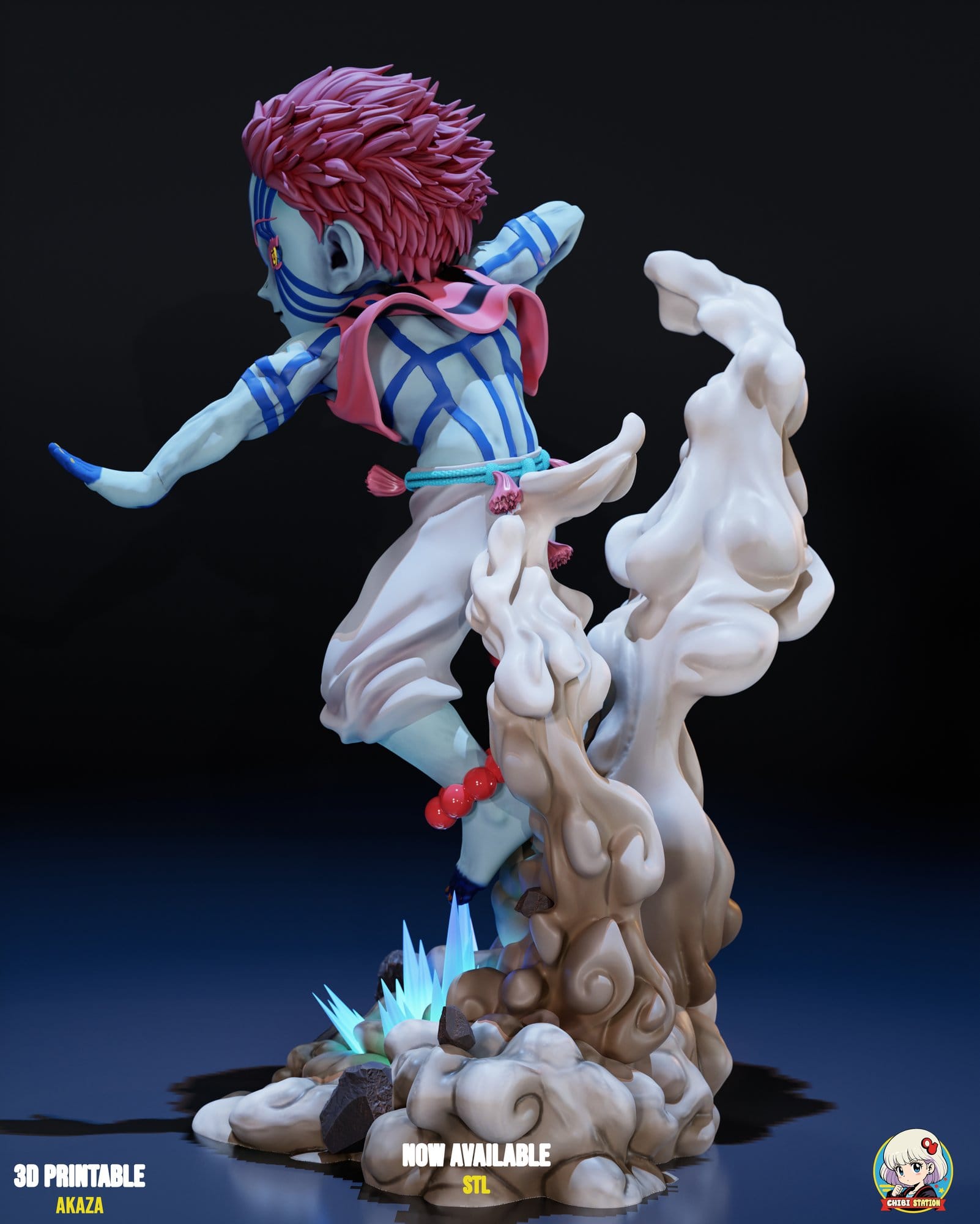
The costume, item by item. Hair: spiky layered locks in magenta-pink, swept up and back, deeper rose in the gaps between locks. Vest: a short, open, sleeveless vest in coral pink with a darker crimson-pink lining and edges, a stand-up collar, and black bands across the collar at the back. The vest is open, so the blue stripes show across his chest and stomach and form a crossing lattice on his back; double bands circle his upper arms, elbows and wrists, and his fingers and knuckles are solid blue. Sash: a twisted turquoise rope tied at the waist, with a pink tassel at each hip (a dark red textured knot over a flared pink fringe). Trousers: loose off-white trousers shaded gray-lavender, gathered and bunched at the calf. Anklets: a strand of large glossy red beads around each ankle. Feet: bare, with dark blue toes and orange toenails.
The base is a crater of tumbling dust clouds carved with spiral swirls, cream at the top fading to tan and brown lower down. On his right side the dust rises into a twisting column that climbs to about the height of his raised fist and curls over at the top, and a lower plume trails behind him. Charcoal rock chunks sit around the rim, and three more fragments are lodged in the column as if thrown up by the impact. Cyan spike bursts break out of the ground at the front and on the rocks beside his feet. The base carries the footprint (126.1 × 121.3 mm) and the height on one side; the outstretched left arm balances it on the other side and reaches past the edge of the base, so leave a little shelf room beyond the footprint.
Versions and sizes
- Full base (
BASE_FULL.stl)- H × W × L (mm): roughly 210 × 126.1 × 121.3
- Pieces: 16
- Presupported (format): No, raw STL only
- Split base (
BASE1–BASE6)- H × W × L (mm): roughly 210 × 126.1 × 121.3
- Pieces: 21
- Presupported (format): No, raw STL only
The height is my estimate: BASE_FULL.stl is 167.6 mm tall, and in the front render the top of his hair sits roughly 40 mm above the top of the dust column. The figure parts are the same in both builds; only the base changes.
Full base suits anyone with a Saturn-class printer or larger. It's one print and no seams in the dust clouds. The cost is a single large solid part you'll want to hollow, and it won't fit a Mars-class plate.
Split base suits Mars-class printers, since every section fits, and anyone who would rather print the base in smaller batches. The trade is five more seams running through the dust clouds and a base you have to align and fill before the figure goes on.
About the sizes. Every measurement in this post comes from the sculptor's files or the studio's published size information for the unprinted model. A printed kit can differ slightly: resin shrinks a little as it cures, removing supports and sanding takes off some material, and the assembled height depends on how the parts are fitted. Treat the numbers as a close guide, not an exact guarantee.
What's in the download
One folder, STL/, with 22 files. Sizes are bounding boxes in mm. Part identities for numbered files are matched by size against the renders.
Figure
HAIR.stl: Hair, the spiky magenta crown- Size (mm): 47.8 × 40.7 × 47.9
- Notes: Heaviest figure part; many pointed lock tips
HEAD.stl: Face and ears- Size (mm): 42.0 × 36.3 × 34.2
- Notes: Carries the kanji eyes and face stripes
TORSO.stl: Chest, back and open vest- Size (mm): 41.8 × 47.2 × 42.7
- Notes: Thin vest edges and collar
ARM1.stl: Raised right arm with fist- Size (mm): 38.8 × 28.2 × 25.8
- Notes: Compact, bent arm
ARM2.stl: Forward left arm, open hand- Size (mm): 29.3 × 34.0 × 57.0
- Notes: Longest figure part; separate fingers held together
LEGS.stl: Trousers and hips- Size (mm): 65.5 × 55.5 × 46.3
- Notes: I can't tell from the renders whether the rope sash and tassels are on this part or on
TORSO.
FOOT1.stl: Lower leg and foot with bead anklet; the planted left leg- Size (mm): 18.2 × 48.8 × 40.8
- Notes: Longer of the two, likely weight-bearing
FOOT2.stl: Lower leg and foot with bead anklet; the raised right leg- Size (mm): 30.0 × 35.8 × 32.4
- Notes: Glossy round beads
Base and scene
BASE_FULL.stl: Whole base: crater, dust column, rocks- Size (mm): 126.1 × 167.6 × 121.3
- Notes: Saturn-class only; use instead of
BASE1–BASE6
Alternates (split base)
BASE1.stl: Base section, smallest- Size (mm): 34.0 × 47.8 × 39.1
- Notes: I take
BASE1–BASE6to beBASE_FULLcut into six, but I can't tell which section each is.
BASE2.stl: Base section, longest- Size (mm): 66.6 × 114.7 × 52.5
- Notes: 114.7 mm long
BASE3.stl: Base section, narrow- Size (mm): 34.0 × 81.1 × 37.7
BASE4.stl: Base section- Size (mm): 84.1 × 54.7 × 50.4
BASE5.stl: Base section, tallest- Size (mm): 85.3 × 33.4 × 103.7
- Notes: Largest split part; likely part of the dust column
BASE6.stl: Base section- Size (mm): 67.7 × 36.8 × 88.7
Effects (base and scene)
EFFECT1.stl: Cyan spike burst- Size (mm): 9.8 × 23.1 × 13.4
- Notes: Thin spikes
EFFECT2.stl: Cyan spike burst- Size (mm): 11.3 × 17.2 × 7.4
- Notes: Thin spikes
EFFECT3.stl: Cyan spike burst- Size (mm): 11.2 × 13.2 × 15.7
- Notes: Thin spikes
EFFECT4.stl: Cyan spike cluster, smallest- Size (mm): 3.8 × 6.2 × 6.0
- Notes: Tiny, easy to lose
EFFECT5.stl: Cyan spike burst- Size (mm): 13.2 × 24.2 × 7.1
- Notes: Flat fan, 7.1 mm deep
EFFECT6.stl: Cyan spike burst, largest; by size the big fan at the front of the base- Size (mm): 28.3 × 33.7 × 7.3
- Notes: Flat fan, 7.3 mm deep
EFFECT7.stl: Cyan spike burst- Size (mm): 18.3 × 23.8 × 12.8
- Notes: Thin spikes
Nothing in the folder is presupported, and there is no slicer project. The files are dense: 105,329 to 572,536 triangles each, and even the tiny EFFECT4.stl carries 227,112. No pegs or sockets show in the renders, so I can't tell how the figure attaches to the base or how the parts key together.
Print difficulty
Print: 4/5 (estimated), both base options.
- No presupports. All 22 files are raw. Every part, down to the seven spike effects, needs supports you place yourself. This is the biggest single factor in the rating.
- Thin elements. The cyan bursts are fans of needle-pointed spikes.
EFFECT6.stlis the largest at 28.3 × 33.7 × 7.3 mm;EFFECT4.stlis 3.8 × 6.2 × 6.0 mm. Tips that fine need a support each or a careful tilt, and they're the parts most likely to fail on the plate or snap during cleanup.HAIR.stlhas the same problem on a bigger part: a crown of pointed locks, each tip an island to catch. - Solid parts.
BASE_FULL.stlis one large solid piece, andHAIR.stlandLEGS.stlare large solid figure parts. I'd hollow those three and add drain holes. With no presupported files there's no studio hollowing to compare against, so wall thickness is your call. - Plate fit.
BASE_FULL.stlat 126.1 × 167.6 × 121.3 mm fits a Saturn-class plate but not Mars-class in any orientation. Everything else fits Mars-class, including all six split sections; the biggest areBASE5.stl(85.3 × 33.4 × 103.7 mm) andBASE2.stl(114.7 mm long). - Glossy round surfaces. The bead anklets on
FOOT1.stlandFOOT2.stlare round and meant to be glossy. Support marks on those beads will show under a gloss coat, so I'd orient them so supports land on the soles and the backs of the legs. - Why 4 and not 5: no part exceeds a Saturn-class plate, and the split base takes away even that requirement. Why not 3: the missing presupports together with the spike effects.
Assembly difficulty
Assembly: 3/5 with the full base, 4/5 with the split base (estimated).
- Count. 16 pieces with
BASE_FULL.stl; 21 with the split base. That's 8 figure parts, 7 effects, and 1 or 6 base parts. - Joins on the figure. Most of the likely seams fall where the costume covers them: hair to head at the hairline, torso to legs under the rope sash, legs to feet at the bunched trouser cuffs above the anklets. The arms are the exception. They meet the torso at the vest's armholes on bare, striped skin, so I'd plan to fill and sand there.
- Weight-bearing. The whole figure stands on the toes of one foot at the crater rim, and the two foot parts,
FOOT1.stlandFOOT2.stl, are small. I'd pin the feet toLEGS.stland pin the planted foot into the base. I wouldn't trust glue alone on a toe contact. - Tiny parts. Seven small effect pieces, with
EFFECT4.stlat 3.8 × 6.2 × 6.0 mm. There's no layout sheet; their placement comes from the renders. - Split base. Six sections to align, with seams running through the dust clouds. The swirls and lumpy cloud forms help hide a seam; the smooth cream surfaces up the column don't. I'd assemble, fill and sand the base before the figure goes on.
Paint difficulty
Paint: 4/5 (estimated).
- Materials. Skin, blue markings, hair, vest (two pinks plus black), rope, tassels, trousers, beads, toenails and eyes on the figure; dust, rocks and spike effects on the base. That's well past four.
- Pattern. The blue stripes cover his face, neck, chest, back, arms, hands and feet. If they're sculpted in relief it's careful line-following; if they're flat on the mesh it's freehand across the whole figure.
- Face. It's a chibi face with stylized skin, not realistic skin. The work is in the eyes: a kanji in each gold iris, blue veining in the sclera, and pink flicks on the lids, all at chibi scale.
- Gloss and texture. The red beads want a high gloss against matte skin and cloth. The rope sash is twisted texture that takes a wash well.
- Gradient. The dust column runs cream to tan to brown over a base that's 167.6 mm tall. That's a smooth gradient over a big, lumpy surface, which is an airbrush job.
- Glow. The spikes are rendered glowing cyan. Because they're separate parts, you can paint the glow or print them in translucent cyan resin.
- Why 4 and not 5: the face and skin are stylized rather than realistic.
Paint reference. Chibi Station's scheme from the colored renders, material by material. Skin: pale blue-gray, cooler and lighter on the highlights. Markings: saturated cobalt blue, the same blue on fingers, knuckles and toes. Eyes: gold irises with dark kanji, pale blue sclera veined in darker blue, magenta-pink lid flicks and brow strokes, fine dark lines under the eyes and on the nose. Hair: magenta-pink, deeper rose in the recesses. Vest: coral pink outside, darker crimson-pink lining and edges, black bands across the back of the collar. Sash: turquoise rope. Tassels: dark red textured knots over pink fringe. Trousers: off-white with gray-lavender shadows. Anklets: glossy bright red beads. Toenails: orange. Dust: cream at the top and on the cloud crests, fading to tan and mid-brown in the lower layers and recesses. Rocks: dark charcoal with a cool blue-gray sheen on the facets. Spike effects: icy cyan, white toward the tips, with a teal-green glow where they meet the ground.
Gallery
The "3D PRINTABLE" and "AKAZA" lettering, the "NOW AVAILABLE" and "STL" text, the round Chibi Station logo badge, and the dark backdrop with its reflective blue floor are render graphics, not part of the model.
Links
- Want it printed? Get the unpainted kit in the store.
- Studio Patreon: Chibi Station on Patreon
- Studio store: Chibi Station on Gumroad
- Cults3D: Chibi Station on Cults3D · Chibi Akaza on Cults3D
- Thangs: Chibi Station on Thangs